Search Test Plans
You can apply various filters to search for test plans. The filter will be applied to the selected Test Plan Folder in the tree.
Ways to Search for Test Plans
The multiple-value Search feature is available for Keys, Summary, Description, Attachment Name, Comments, and custom fields with Number Field and Text Field types in the Test Plan module.
Search a Test Plan Key
You can search for a single Test Plan key by entering the key in the search box. This option searches mentioned Key with the “Contains” clause. It filters records using partial keyword matches.

Search on Other Test Plan fields
You can apply additional filters, like the following, to search for test plans. The filter can also be applied to custom fields.
Note
A maximum of ten filters, including system and custom fields, can be selected at a time.
Note:
Label
Fix Versions
Components
Sprint
Status
Priority
Assignee
Reporter
Created By
Updated By
Key Search
Search (Free Text): This option searches mentioned Key with the “Contains” clause. It filters records using partial keyword matches.
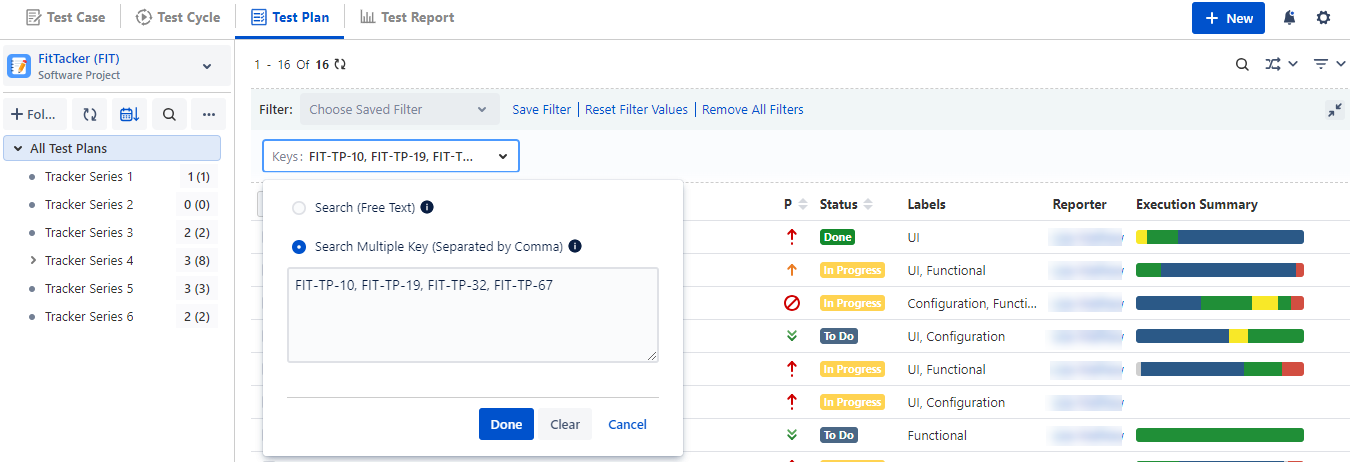
Search Multiple Keys (Separated by Comma): This option searches Exact Keys, separated by commas.
For example: FIT-TP-10, FIT-TP-19, FIT-TP-32, FIT-TP-67
The search result displays records that exactly match asset keys.
Note
A maximum of 200 Keys can be searched at a time.
Multi-line Search
You can search assets based on the content of the Multi-Line Text Box type fields.
Search (Free Text): This option searches the field content with the “Contains” clause. It filters records using partial keyword matches.
Search Multiple Keywords (Separated by Comma): This option searches for keywords or phrases in the field using the “Contains” clause. You can enter phrases/keywords separated by a comma. If a phrase contains a comma, enclose the phrase/keyword within double/single quotes.
For example: coaching, exercises, “workout history, performance stats”
Note
A maximum of 200 keywords can be searched at a time.
Number Field Search
You can search assets based on the content of the Number Field type fields.
(A) Number Range: This option searches the field content with the “Contains” clause. It filters records using partial keyword matches.
(B) Search Multiple Numbers (Separated by Comma): This option searches for the exact numerical values in the fields. You can search for multiple numeric values separated by commas for a Custom field with the Number Field type.
For example: 141, 273, 902, 452
The search results display assets that exactly match numbers.
Note
A maximum of 200 numerical values can be searched at a time.
Save Filter
You can create customized filters and save them too for future use with either Public or Private visibility.
Perform the following steps to save a filter:
Click the filter drop-down and select the field on which you want to apply the filter.
Once you apply the filter on records, you can also save it.
Click Save Filter to save the filter.
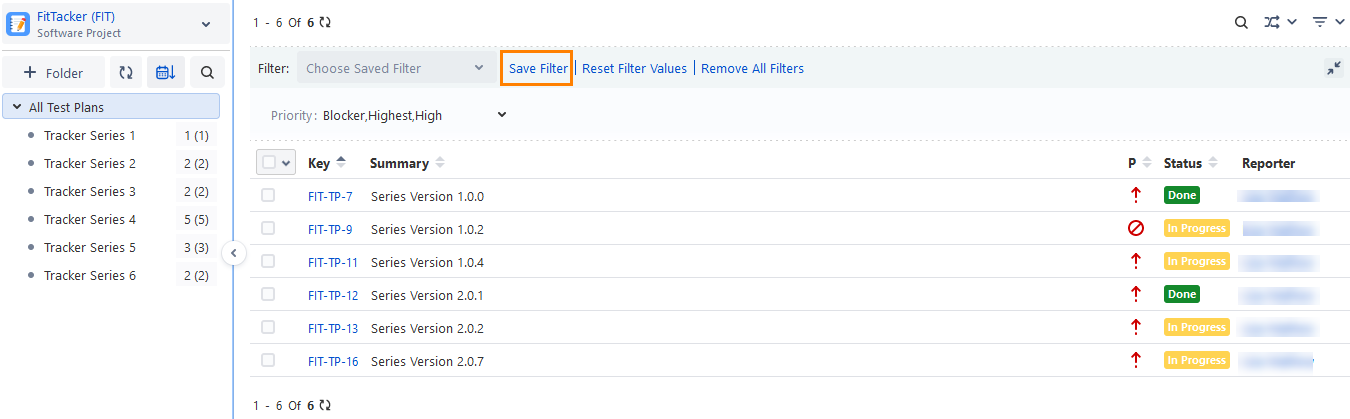
The Save Filter dialog appears.
Enter Filter Name on the dialog.
You can save the filters with visibility either Public or Private.
Public: Filter saved with Public visibility are visible to all users of the project. Moreover, you can save the results of these saved Public filters through the URL with other users of same Jira instance. Users who have access to that project can view the filter results by opening the URL. The URL links can also be integrated on other documentation sites as required.
Private: Filter saved with Private visibility are visible only to the currently logged-in user.
For example, a project admin wants to create a Public filter for Priority that is visible to all users in the Filter list. Hence, the user opts to set the visibility of the filter as “Public”.
Click Submit.
The filter is now saved and applied.
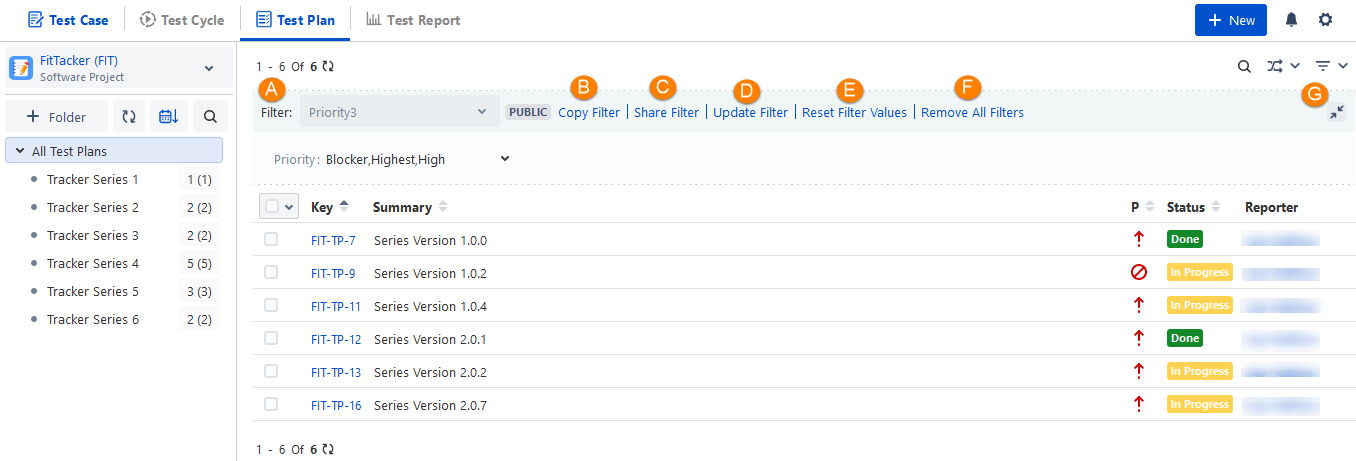
A. The filter saved appears in the drop-down.
B. Copy Filter: You can copy the existing filter and save it with another name.
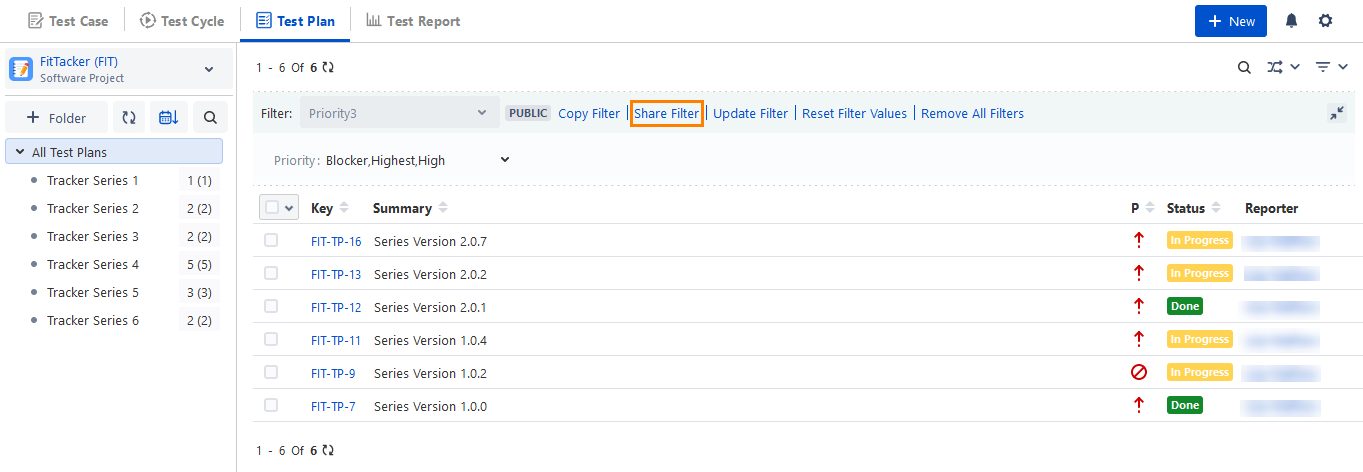
C. Share Filter: You can share a Public filter with other users and integrate the URL on the documentation site as well. Read more about Share Public Filter URL in the following section.
D. Update Filter: You can edit the current filter.
E. Reset Filter Values: You can reset/clear the criteria of the saved filter.
F. Remove All Filters: You can clear all the applied filters.
G. Collapse the Filter pane.
Clear selected Item
To clear the applied filter, click the Filter drop-down and click the Clear Selected Item link.
Delete a Filter
To delete a saved filter, click the Filter drop-down and hover over the filter name. The Delete icon will become visible. Click the Delete icon.
Apply Filters with Operators
The Operators option is available in the drop-down. The filter treats “OR” as the default operator and applies it to the records, displaying records with either of the selected values. You can also use the “AND” operator to consider all the selected values.
The operators are available for these fields: Label, Components, Fix Versions, Multi-dropdown custom field, Labels custom field, Multi-users custom field, and Checkbox custom field.
Empty operator: Using the “Empty” operator, you can filter out records that do not have values for the specific field. The operator is available for single and multi-lookup fields.
To change the operator, click the Edit icon beside the “OR” operator.
The drop-down displays two operators: “OR” and “AND”.
You can select “AND” as the operator to apply for the filter.
The filter applies with the operator “AND” and the output shows the records holding both values.
Share Public Filter URL
The Share Filter option is provided to share the results of the saved Public filters through URL with other users of the same Jira instance. Users who have access to that project and Test Plan View permissions can view the filter results by opening the URL. You can also integrate the URL into other documentation sites as required.
On clicking Share Filter, the success message appears.
You can share this copied URL with other users, who can then copy the URL in the browser and access the filter results if they are already logged into QTM4J on the same instance.