Custom Fields
QMetry Test Management for Jira allows users to add Custom Fields or User Defined Fields (UDFs) in addition to the built-in fields, for different test assets. Custom fields are editable fields that administrators can configure as needed for test cases, test cycles, test plans, and test executions.
Supported Custom Field Types
Admin can add the following types of custom fields:
Single Line Textbox
Multi-Line Textbox (Multi-Line Textbox custom fields support rich text editing starting with QTM4J version 4.4.0.2.)
Radio Buttons
Checkboxes
Single Drop-down
Multi Drop-down
Date Picker
Date Time Picker
Number Field
User Picker (single user)
User Picker (multi-users)
Labels
Cascade Drop-down
Note
Permissions required:
Jira Permissions: Browse Project permissions are required.
QMetry Permissions: If enabled, then the following permissions are required.
Configuration View
Configuration Modify
Creating a Custom Field
Perform the following steps to create a custom field:
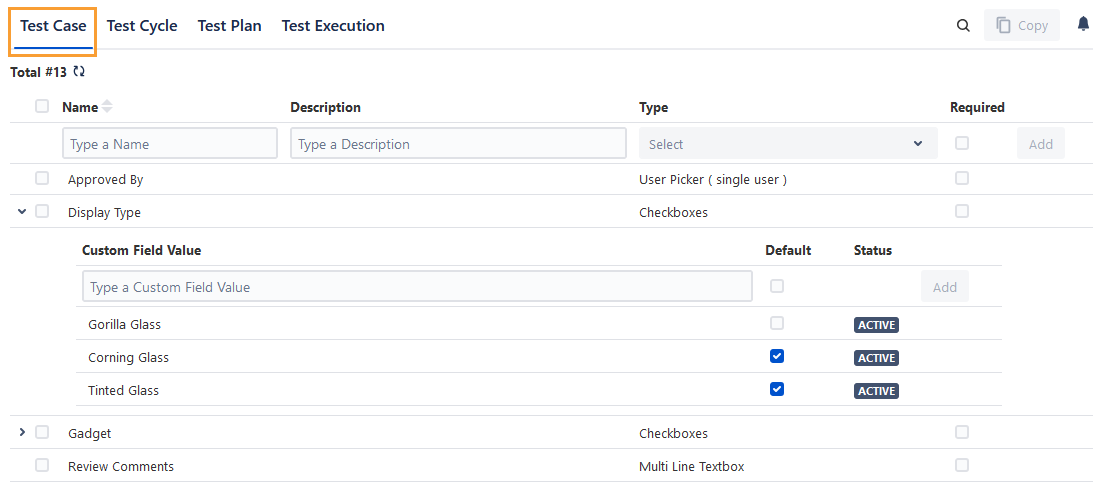
Go to Configuration and select Custom Fields.
Select the section Test Case/Test Cycle/Test Plan to which you want to add a custom field.
Enter the Name and Description for the field.
Select the Type of the field. This is the custom field's Data Type. The types listed on the drop-down are supported by QMetry. Select the relevant type for the custom field.
Select the Required checkbox to mark the field as mandatory for the test asset. It helps users manage a large number of test assets that require a mandatory custom field(s) to be part of every test asset.
Click the Add for Value section and then click Add for the custom field.
Note
When creating a custom field, select the appropriate field type based on your requirements, as the field type cannot be changed later.
Admin can add the following types of custom fields in QMetry Test Management for Jira:
Single Line Textbox: A basic single-line text box that allows simple text input.
Multi-Line Textbox: A basic multiple-line text box that allows simple text input.
Radio Buttons: This allows only one condition to be applicable at a time for a custom field value.
Checkboxes: This allows one to apply multiple conditions at a time for a custom field value.
Single Dropdown: The user can enter options to display for drop-down as well as select a single value from the drop-down at a time in test assets.
Multi Dropdown: The user can enter options to display for drop-down as well as select multiple values from the drop-down at a time in test assets.
Date Picker: This type provides functionality to add dates from the calendar.
Date Time Picker: This type provides functionality to add dates from the calendar and time (with 30-minute slots)
Number Field: This type allows only numeric values for a custom field.
User Picker (single user): A single user picker allows you to select a single user for the custom field.
User Picker (multi-users): The multi-user picker allows you to select multiple users for the custom field.
Cascade Drop-down: This type creates values in the hierarchy of Level 1> Level 2. The value selected at Level 1 (Parent Options) affects the values that populate at Level 2 (Child Options). For example, Products > Types of selected Product.
Labels: This type creates a field of type Label. The values that you can create from assets.
Custom Field Value: Enter values for the custom field. These values will be populated on the field in the respective section for test authoring.
Default Value/Field Default: Preserving a default value for a custom field is very helpful when the user is adding records with similar values for a particular field or when the value needs to remain consistent for all the entities. The custom field value will auto-populate for the field while test authoring.
Note
You can not define a default value for Test Execution custom fields.
Custom Fields in Test Assets
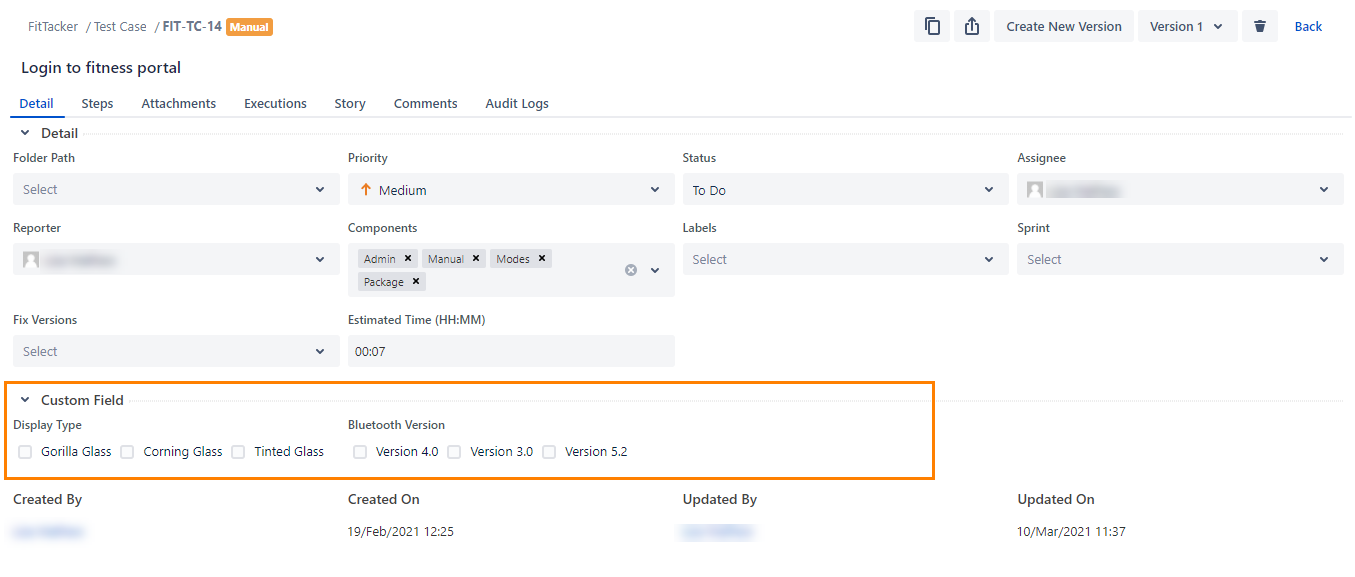
The custom fields appear under the Custom Field section in the test assets.
User Picker (multi-user)
User Picker (multi-users): Multi-user picker allows you to select multiple users for the custom field.
User Picker (multi-user) custom field in Test Assets: The custom fields will appear under the Custom Field section in the test assets. In this user picker, you can select more than one user.
Editing a Custom Field
You must have the Configuration Modify permission to the project to edit a custom field that is already created.
Perform the following steps to delete a custom field:
Click the custom field name, and a text box appears to enter the new custom field name.
After typing the new name, click the check mark. Also, the editing description field can be done on similar lines.
Note
When you set a custom field value as the default, it is automatically applied to newly created test assets.
Sorting the List Values
You can sort custom field values for these field types: Cascade, single and multi-drop-down lists, Checkbox, and Radio Button.
Required Permission: You must have the Configuration Modify permission to change the Sort By preference of list values.
Perform the following steps to sort custom fields:
Hover over the custom field and click the Sort option.
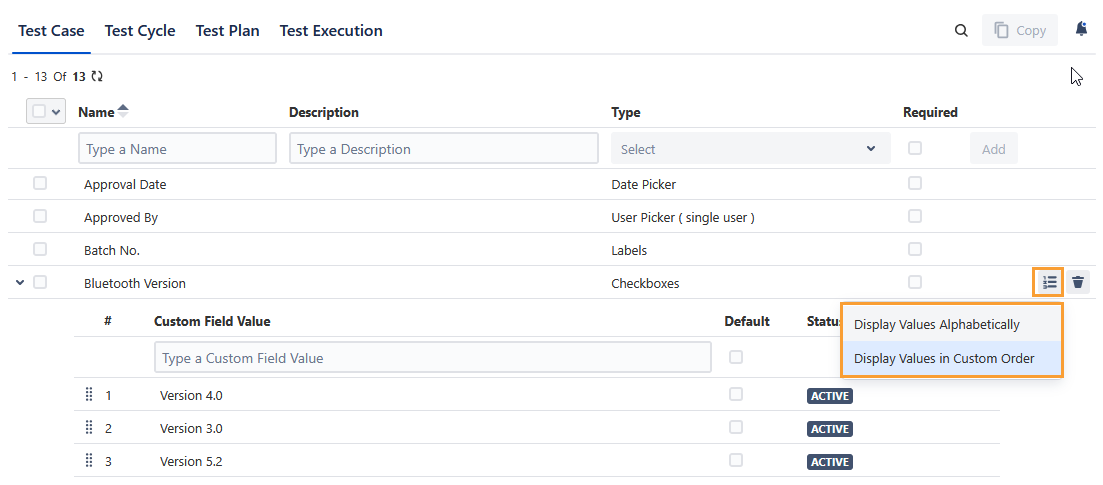
Select any one of the following options. The selected sorting option will sort the list values consistently across all screens.
Display Values Alphabatically: This option arranges the list values alphabetically.
Display Values in Custom Order: This option allows you to change the list value sequence using either of the following methods:
Changing the sequence number in the column - You can change the list value sequence by editing the number in the Sequence No. column.
Dragging and dropping the list value - Hover over the icon, then drag and drop the list value to the required location.
Archiving a Custom Field
Archive the list values of the system or custom fields before deleting them. The ability to archive allows the outdated values to stop appearing on the selection list of new test assets while preserving the values in the existing test assets for historical accuracy.
Note
You can not archive the values marked as Default.
Operation | Impact and Behavior of Archived Values |
|---|---|
Import Test Case | Archived values can not be imported during the test case import operation. It applies to manual import and import via Open API or Automation API. |
Export Test Case | Archived values get exported during the test case export operation. |
Copy List Values | The archived list values do not get copied while copying the list values using the Copy button in the project Configuration section. |
Filter records on list values | Filters can be applied to the archived values. The archived values are displayed under the Archived section on the filter list. |
Entity versioned/updated | The archived list values get copied or preserved as it is. |
Clone in the same project | The operation applies to the Test Case and Test Cycle modules. The archived list values get copied. |
Clone test cycle to other projects | The operation is applicable to the Test Cycle module. The archived values are copied with the “Active” status in other projects. |
Export to another project | The archived list value gets copied with the “Active” status in other projects. |
Cloning or Start New Execution with custom fields | The archived list values get copied. |
Perform the following steps to archive custom fields:
Hover over the value you want to archive and click the Archive icon.
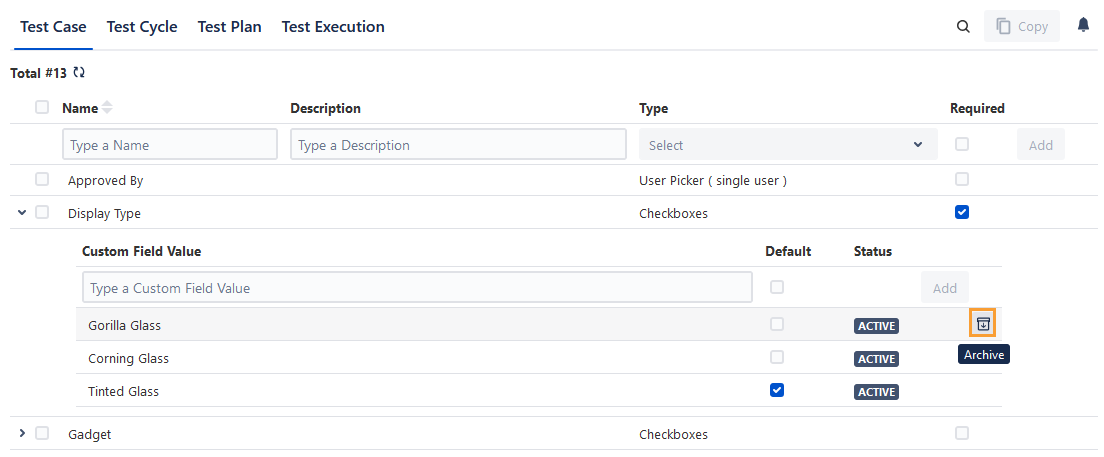
The confirmation message appears.
Click the Confirm button to proceed.
The archived value is displayed with the Archived Status.
Unarchive a Custom Field Value
To unarchive the list value, hover over the value and click the Unarchive icon.
To view the Audit Logs of archive and unarchive operations, click QMetry, select Configuration, and select Configuration Logs.
Deleting a Custom Field Value
You can delete only archived values.
Required Permission: You must have the Configuration Modify permission for the project to delete a custom field that is no longer in use.
Notes:
The values marked as “Default” can not be deleted.
Deleting custom field values is possible. But a deleted custom field will lose all its linkages with test assets it was previously linked with. The test asset's custom field value will appear blank once the custom field gets deleted and linkages can't be recovered.
Perform the following steps to delete custom field values:
To delete a custom filed value, hover over the archived value and click the Delete icon.
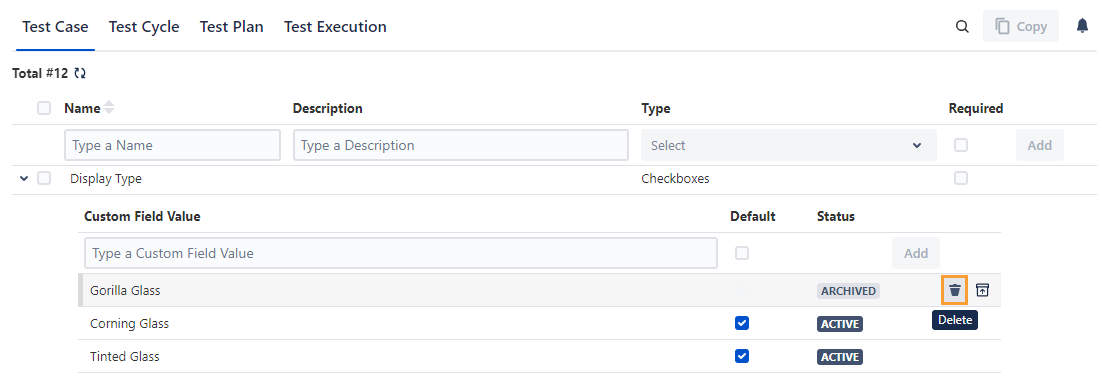
The confirmation message appears.
Click Delete to proceed.
After deletion, the custom field is removed from test assets.
Searching for a Custom Field
You can easily search for a custom field, even from a long list on the screen. Since duplicate custom fields are not allowed, the search functionality helps prevent duplication.
Perform the following steps to search for a custom field:
Navigate to QMetry, click the Configuration menu, and select your project.
Click Custom Fields under Project Configuration.
Click the search icon to see the text box. Type the keyword in the text box and press ENTER on the keyboard.