Components
Components add categorization to your test assets, categorizing them into features, screens, teams, modules, and more. Components provide an easier way of grouping your test assets. Using components, you can search Test assets, generate reports, collect statistics, and so on.
QMetry allows you to create customized Components at the project level. A user can assign it to a Test Case, Test Cycle, and Test Plan for grouping.
Note
Permissions required:
Jira Permissions: Browse Project permissions are required.
QMetry Permissions:
If enabled, then the following permissions are required.
Configuration View
Configuration Modify
Searching for a Component
Perform the following steps to search for a component:
Navigate to QMetry, click the Configuration menu, and select your project.
Click Component.
Click the search icon to see the text box. Type the keyword in the text box and press ENTER on the keyboard.
You can search for a component before creating it to prevent duplicates.
Creating a Component
You must have the Configuration Modify rights to the project to create a customized component.
Navigate to QMetry, click the Configuration menu, and select your project.
Click Component.
Enter component name and its relevant description.
Click Add.
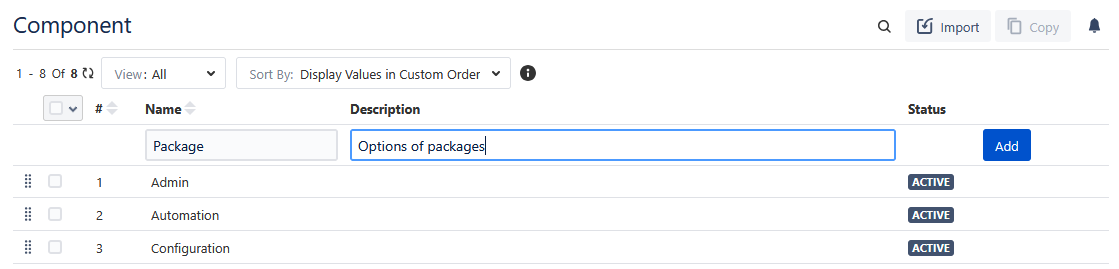
The Components are available for linking them with the Test Case, Test Cycle, and Test Plan.
Adding Component Values Inline
The Components field values can be added inline in the test asset detail page.
Perform the following steps to add component values in the fields:
In the Components field, type the field value.
The system prompts an option to create the value. Click it or press ENTER.
Using a Component
Perform the following steps to use a component in test assets. These are generic steps for all the test assets.
Navigate to the QMetry menu, select Test Management, and select the Test Case tab.
Create a new test case or navigate to the detail page of an existing test case.
Click the Components drop-down and select the components to link with the test case.
Importing Components from Jira
You can import the components defined in Jira and use them in QMetry. It helps users as they do not have to enter the same data in QMetry, which is already created in Jira.
Required Permissions: You must have the Configuration Modify and Import permissions.
On the Component screen, click Import.
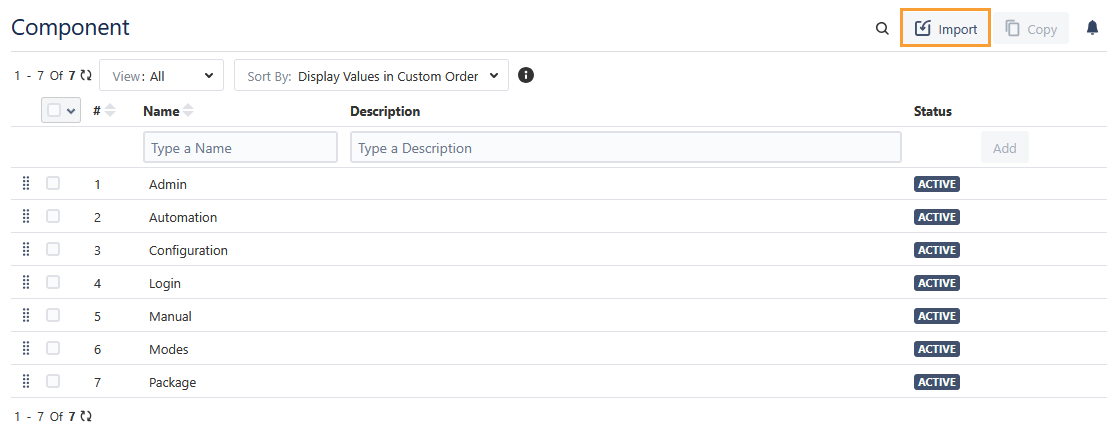
Select the project you want to import Components from. To import Components from other Jira projects, you should have access to it.
Select the values you want to import into the QMetry Components field. To select all the records on the current page, click the checkbox in the column header.
Note
The system does not import duplicate components.
Once the Jira Component values are imported into QMetry, these values populate in the Components field on the test asset detail page.
Editing a Component
Users with 'Configuration Modify' access to the project can edit a component that is already created. Below are the steps to edit a component:
Click on the component name, and a text box appears to enter the new component name as shown in the screenshot.
After typing the new name, click on the tick mark symbol. Also, editing the description field can be done on similar lines.
Sorting the List Values
Sort By: Select any one of the following options. The selected sorting option will sort the list values consistently across all screens.
Required Permission: Users should have the Configuration Modify permission to change the Sort By preference of list values.
Display Values Alphabatically: This option arranges the list values alphabetically.
Display Values in Custom Order: This option allows you to change the list value sequence using either of the following methods:
Changing the sequence number in the column - You can change the list value sequence by editing the number in the Sequence No. column.
Dragging and dropping the list value - Hover over the icon, then drag and drop the list value to the required location.
The Configuration Logs display audit logs for changes in the Sequence Number and Sort By settings.
Copying Components to Other QMetry Projects
You can copy components from one project to other projects. This feature lets you reuse the same components across multiple QMetry projects without creating them individually, saving time and preventing duplicate entries.
Perform the following steps to copy components:
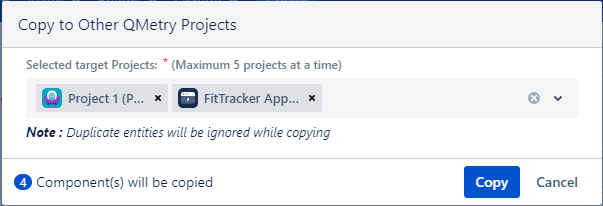
Select the items that you want to copy to other QMetry Projects and click Copy in the top right corner.
Required Permission: To copy components to other projects, the user must have 'Configuration Modify' permission for the targeted project.
Now select the project where you want to copy the selected items. You can select multiple QMetry Projects (maximum five projects) at a time to copy the item.
The system ignores duplicate entities during copying.
Archiving a Component
Archive system or custom field list values before deleting them. Archiving prevents outdated values from appearing in selection lists for new test assets while preserving them in existing test assets for historical accuracy.
Required Permission: You must have the Configuration Modify permission to archive the list values.
Operation | Impact on/behavior of Archived Values |
|---|---|
Import Test Case | Archived values can not be imported during the test case import operation. It applies to manual import and import via Open API or Automation API. |
Export Test Case | Archived values get exported during the test case export operation. |
Copy List Values | The archived list values do not get copied while copying the list values using the Copy button in the project Configuration section. |
Filter records on list values | Filters can be applied to the archived values. The archived values are displayed under the Archived section on the filter list. |
Entity versioned/updated | The archived list values get copied or preserved as it is. |
Clone in the same project | The operation is applicable to the Test Case and Test Cycle modules. The archived list values get copied. |
Clone test cycle to other projects | The operation is applicable to the Test Cycle module. The archived values are copied with the “Active” status in other projects. |
Export to another project | The archived list value gets copied with the “Active” status in other projects. |
Cloning or Start New Execution with custom fields | The archived list values get copied. |
Perform the following steps to archive components:
Hover over the value you want to archive and click the Archive icon for it.
Archive system or custom field list values before deleting them. Archiving prevents outdated values from appearing in selection lists for new test assets while preserving them in existing test assets for historical accuracy.
Click Confirm to proceed.
You can see the archived values with the Archived Status.
Unarchive a Component
To unarchive the list value, hover over the value and click the Unarchive icon.
To view the Audit Logs of archive and unarchive operations, go to QMetry, select Configuration, and select Configuration Logs.
Deleting a Component
You can delete only archived values. If a value is used in any test asset, you cannot delete it. To delete the value, first remove all its existing associations with test assets.
Required Permission: You must have the Configuration Modify permission to delete the archived list values.
Note
Deleting a component permanently removes all its associations with linked test assets and may affect reports that use the component as a filter. After deletion, the Component field appears blank in the affected test assets, and the associations cannot be restored.
Perform the following steps to delete the list value:
Hover over the archived value and click on the Delete icon.
The confirmation message appears.
Click OK to proceed.
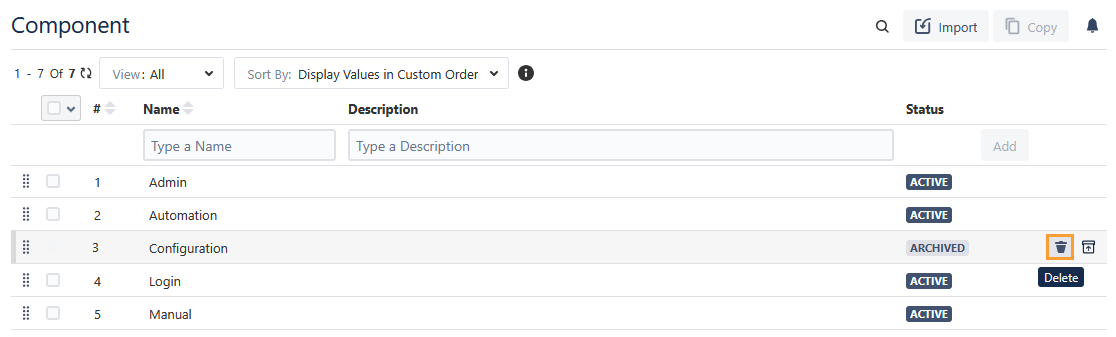
After deletion, the component value is removed from the Component field of the test asset.