List View Test Execution Screen
Execution Screen
In List View, all the Test Cases under the Test Cycle are displayed on the same screen. You can expand individual Test Cases to see the test step details. To access the List View of the execution screen, click the List View icon at the top.
Introduction
The Execution screen displays test case records that are linked to the test cycle under execution.
A. You can filter out test case records by applying different criteria. The multiple value Search feature is available for Keys, Summary, and custom fields with Number Field and Text Field type on the execution screen.
Test Case Search on Execution Screen
Perform the following steps to use the Filter option to search the test cases.
Click the Filter option.
Click the Add a Filter option on the Filters pane.
Select the search criteria to search the test cases.
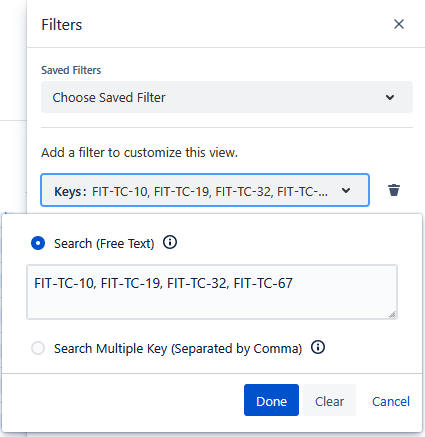
Key Search
Search (Free Text): This option searches mentioned Key with the “Contains” clause. It filters records using partial keyword matches.
Search Multiple Keys (Separated by Comma): This option searches Exact Keys, separated by commas.
Example: FIT-TC-10, FIT-TC-19, FIT-TC-32, FIT-TC-67
The search result displays records that exactly match asset keys.
Multi-line Search
You can search assets based on the content of the Multi-Line Text Box type fields.
Search (Free Text): This option searches the field content with the “Contains” clause. It filters records using partial keyword matches.
Search Multiple Keywords (Separated by Comma): This option searches for keywords or phrases in the field using the “Contains” clause. You can enter phrases/keywords separated by a comma. If a phrase contains a comma, enclose the phrase/keyword within double/single quotes.
Example: coaching, exercises, “workout history, performance stats”
Number Field Search
You can search assets based on the content of the Number Field type fields.
(A) Number Range: This option searches the field content with the “Contains” clause. It filters records using partial keyword matches.
(B) Search Multiple Numbers (Separated by Comma): This option searches for the exact numerical values in the fields. You can search for multiple numeric values separated by commas for a Custom field with the Number Field type.
Example: 141, 273, 902, 452
The search result displays assets that exactly match numbers.
Note
A maximum of 200 numerical values can be searched at a time.
You can also perform bulk operations on the filtered records.
To perform bulk operations, select test cases, click the Bulk Operations option, and select the required option.
Note
A maximum of 10 filters, including system as well as custom fields, can be selected at a time.
You can apply a filter on the following columns:
Key/Summary
Execution Assignee: An execution Assignee is a user who is assigned to execute a Test Case from the execution screen.
Execution Result
Defects: You can filter test cases with defects or test cases without defects linked to them.
Test Case Assignee: The Test Case Assignee is a user who is assigned to a test case from the test case details screen. You can filter test cases based on Test Case Assignee and bulk update those test cases. For example, you can bulk assign those test cases to an Execution Assignee so that you do not have to check test cases individually.
Folder Path: The filter allows you to filter test cases based on the respective folders. The list shows the entire test case module folder tree. You can select multiple folder paths to include test cases within those folders.
Executed By: The filter allows you to filter test executions on the basis of users who executed the test cases. You can select multiple users on the list.
Planned On: The date on which the execution of the test case is planned.
More: Reporter, Labels, Components, Build, Status, Priority, Sprint, Fix Versions, Environment, Coverage/Stories, Estimated Time, Actual Time, Test Case Type, and so on.
Custom fields: There are two sections for custom fields: Test Execution Custom Field and Test Case Custom Field. Custom fields of the current project are displayed on the filter menu. If cross-project test cases are linked with the test cycle, then custom fields of the test cycle project will be displayed.
Filters created are user-specific, so they will be saved and displayed on a user profile basis. This means that when the user opens the execution screen, they see the same filters applied on the screen.
Apply Filters with Operators
In addition to the “OR” operator to filter the test assets, you can filter the test assets using the “AND” operator for the Multi-Lookup List. It enables you to filter the entities having multiple similar values in their fields.
For example, you can filter test cases that have both Label1 & Label2 in the Label field. The filter will search for those test cases in which both values are present in the Label field. There are a total of 10 test cases, of which 3 have Label1, 2 have Label2, and 5 have both Label1 and Label2. So, the search output will display 5 test cases that have both the Label values.
The operators are available for these fields: Label, Components, Fix Versions, Multi-dropdown custom field, Labels custom field, Multi-users custom field, and Checkbox custom field.
Note
The AND operator is not supported for Group By Folder and Components in Test Cycle Execution.
Empty operator: Using the “Empty” operator, you can filter out records that do not have values for the specific field. The operator is available for single and multi-lookup fields.
The filter considers “OR” as the default operator and applies it to filter the records, which displays records with either of the selected values.
To change the operator, click the Edit icon beside the “OR” operator.
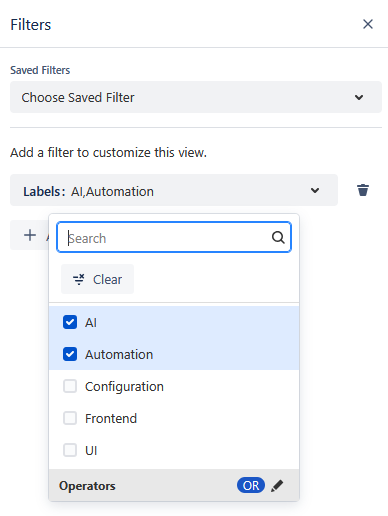
The drop-down list displays two operators: “OR” and “AND”.
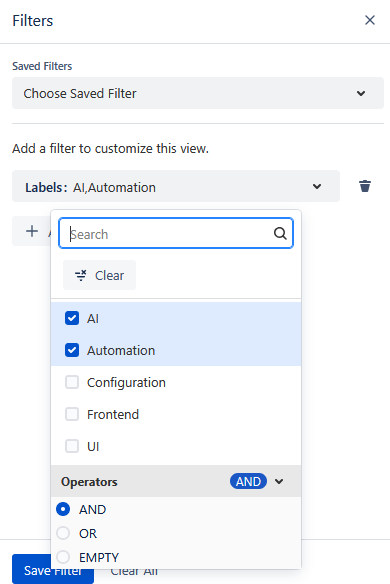
You can select “AND” as the operator to apply to the filter.
The filter applies with the operator “AND” and the output shows the records holding both values.
Save Filters
Users can save and apply multiple filter criteria on the Execution screen. You can create customized filters and save them for future use. You can quickly reuse the saved filter criteria for other test cycles in the same project without setting them up manually each time. You can save these filters with the visibility of either Public or Private, ensuring the required filters are visible to all users and other restricted filters remain hidden.
Perform the following steps to save a filter:
Select the options and set the criteria to apply a filter.
Click Save Filter to save the filter.
Click the Filter option.
Click Add a Filter on the Filters pane.
Enter the Filter Name to identify the filter.
Select the visibility of the filter:
Public: This option keeps the filter visible to all users of the project.
Private: This option restricts filter visibility to the currently logged-in user.
Click Submit to save the filter with the set visibility.
You can perform the following operations on the saved filter:
A. Add Filter: Add other filters to the existing filter criteria.
B. Share Filter: This option allows you to generate a URL and share it with other users of the project, letting them access the execution screen with the same filter applied to it.
Note
Only filters marked as Public can be shared with other users of the project.
C. Copy Filter: This option allows you to copy the existing filter and save it with a new name. You can then modify the filter criteria to customize it.
D. Update Filter: This option allows you to rename the filter and change its visibility.
E. Reset Values: This option resets the set filter values.
F. Clear All: This option clears all the filter criteria set for the filter.
G. Delete: This option deletes the respective filter values.
Clear the filter: To clear the applied filter, click the Saved Filters drop-down list and then click Clear.
Delete a Filter: You can delete the filters that you created.
Perform the following steps to delete a saved filter:
Click the Saved Filters drop-down list.
Hover over the filter name you want to delete and click the Delete icon.
Manage Screen View
Expand All/Collapse All: You can expand/collapse all Test Cases on the screen at a time.
Note
A maximum of ten filters, including system and custom fields, can be selected at a time.
Customize Execution Screen View: Select the columns you want to display or hide on the execution screen. You can opt to hide/show default columns on the screen. To return to the default view of the execution list view, open the Columns drop-down and select Reset to Default.
The test case row displays execution details of the test cases in the test suite. You can show or hide the columns to view the details accordingly.
Environment: The drop-down shows values entered in Configuration > Test Execution > Environment. You can add new values and change the selection in-line. The added values will also be reflected in the Configuration.
Build: The drop-down shows values entered in Configuration > Test Execution > Build. You can add new values and change the selection in-line. The added values will also be reflected in the Configuration.
Execution Assignee: Assignee assigned from the execution screen. You can update the value in-line.
A.T.: Actual time that is taken to execute the test case. You can update the value in-line.
Planned On: The date on which the execution of the test case is planned. This helps in organizing and tracking test executions effectively. You can only select the Planned On date equal to or greater than the test cycle creation date.
Executed by: User who has executed the Test Case.
S.C.: Steps Count
Bug Count: Click the icon to link bugs or defects to the test case or step. You can create and link a new bug or link an existing bug. Read more about Link Defects/Bugs on List View Execution Screen.
Note
Permissions required: Users should have the Test Cycle Manage Defect permission to link or unlink bugs from the Bug Count column.
Attachments: Click the icon to attach files to the test case or step. Read more about Attachment.
Execution Custom Fields: These are the Test Execution custom fields added in the Configuration section. An asterisk (*) next to a field name indicates a mandatory field.
Comments: You can add and edit comments inline.
Execution Result
Clone Existing Test Execution
Delete Test Execution
Each test case row is expandable. The step counts can be clicked to expand the test case row to show step details in the expanded area.
If the Precondition is mentioned in the test case, then it will be displayed on expanding the test case row.
Sync Latest Test Case Version
The Sync icon on the screen acts as an indicator that indicates whether the linked version of the test case is the newest version or an older version. You can easily come to know that you need to sync the latest version of the test case with the test cycle.
While reviewing the linked test case of a test cycle, the QA Manager/Tester easily finds out whether the test case that is getting executed/linked is the latest one. While executing the test case the testers shall know if they are executing a new test case version or still executing an older one. The Test Cycle > Test Cases tab and the execution screen now indicate the availability of a newer version of a test case besides the older linked version. If the older test case version is found, testers have the option to sync the latest version of associated test cases individually or in bulk.
Benefits of the Feature -
You can sync test cases to its new version individually or in bulk, which saves time.
The feature eliminates the need to manually unlink the older version and link the newer version of the test case for execution.
Note
Permissions required: You must have the Test Cycle Edit permission to sync the latest version of the test case with the test cycle.
An archived test case can’t be synced with the latest version. To sync the archived test case with the latest version, unarchive it first.
If multiple versions of a test case are linked to a test cycle and the latest version of the test case is available, you can sync only one version with the latest version of the test case. In bulk operation, if multiple versions of a test case are selected for sync, the first test case in the order of the linking will be synced.
Once the latest version of the test case is synced -
the action of syncing the latest test case version can’t be reverted.
this action shall reset the execution status of the test case and its test steps to “Not Run” on all its current and previous executions on this test cycle.
bugs linked with the previous executed version shall not be carried forward (linked) to the latest synced version of the test case and shall be unlinked from older executions.
the “Actual Time”, “Actual Outcome”, “Comments”, “Attachments”, and “Any other Custom Execution Fields” values shall be erased and shall be lost.
The following table shows the indication of different colored Sync icons.
Icon | Description |
|---|---|
 | It indicates that the latest version of test case is available. |
 | It indicates that the test cycle is synced with the latest version. |
Sync Latest Version of a Single Test Case
You can sync the latest version of a single test case as well as multiple test cases on the execution screen. This section describes the steps to sync the latest version of a single test case.
Perform the following steps to sync the latest version:
Navigate to the List View of the test execution screen.
The Sync icon next to the Version column indicates whether the test case version is the latest or not. The icon appears in Blue when the latest version of the test case is available for sync.
Click the Sync icon to sync the latest version of the test case with the test cycle.
The confirmation message appears.
Click Yes to proceed.
The latest version of the test case is synced with the test cycle.
Sync Latest Version of Multiple Test Cases
You can sync the latest version of a single test case as well as multiple test cases on the execution screen. This section describes steps to sync the latest version of multiple test cases at a time.
Perform the following steps to sync latest version of multiple test cases:
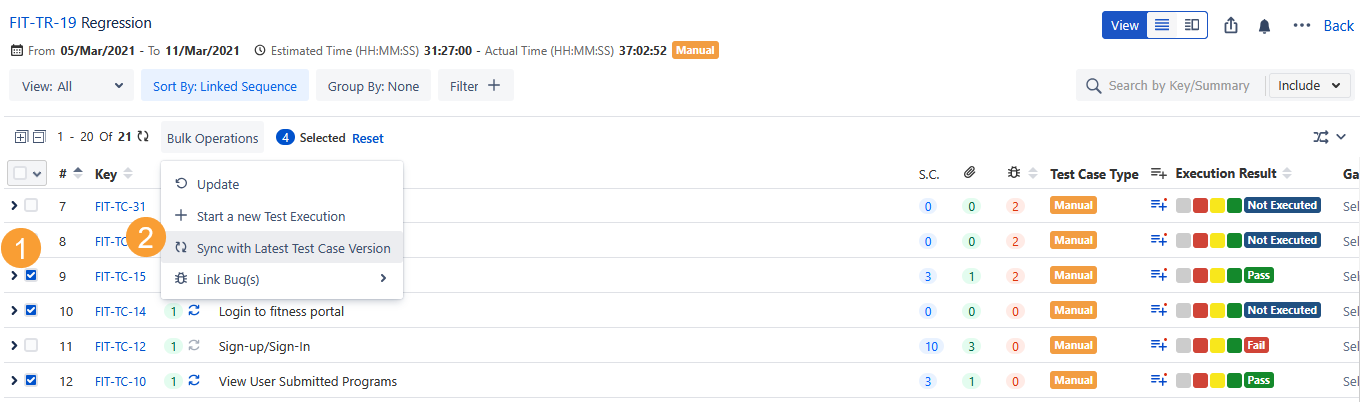
Select test cases the latest available version of which you want to sync with the test cycle.
Click the Bulk Operations button and select the Sync with Latest Version option.
The confirmation message appears.
Click Yes to proceed.
The latest version of the test case is synced with the test cycle.
Start a New Test Execution
Refer to Start a New Test Execution.
Clone a Test Execution
You can clone the execution of the Test Case. The cloning includes all steps, defects, and attachments linked with the test execution. The cloning of test execution is useful when you need the same details as the current execution.
For example, Test Case A failed in Build1, and the tester needs to test the same test case in the next Build2 with all the existing associations.
Perform the following steps to clone a test execution:
On the execution screen, click the Clone icon for the test execution that you want to copy.
The Clone Existing Test Execution dialog appears.
Select the checkbox in the dialog if you want to clone all the Test Execution Custom Fields values from the latest execution. The checkbox is selected by default.
Click Clone to proceed.
A copy of the existing test execution is created. You can then change the Build or Environment as per your requirement and go ahead with the execution.
The Execution Custom Fields get copied without values to the cloned test execution.
Delete a Test Execution
If a test execution is created by mistake or you have changed your mind and do not require the new test execution anymore, you can delete it.
Click the Delete icon for the test execution you want to delete.
The Delete icon is only visible when there is more than one test execution for the test case.
Sync Test Steps
When the steps are added/updated/deleted in the Test Case module, a warning message is shown for the Steps tab indicating the required sync. Click the provided link to sync the steps with the Test Case and update them on the execution screen.
The Sync Steps dialog appears. Click Sync Steps.
Customize Execution Screen View
You can hide, show, or rearrange the test execution system and custom fields on the Test Execution List View.
Perform the following steps to customize the view:
On the Execution screen, click the Column option.
Select the columns you want to display and remove the checkbox selection of the column you want to hide.
You can also drag and drop columns to rearrange them. The columns will be displayed as per the visibility and sequence set.
Note
You can enable up to 20 fields (as columns) at a time on the Test Execution List View.
To return to the default view of the execution list view, click Reset to Default.
You can also add or edit custom field values inline. These changes only apply to the latest execution of the test case.
Note
Permission required: You must have the Test Cycle Execute permission to update the Test Execution Custom Fields, Attachments, and Comments inline.
Sort Test Cases
On the execution screen, you can sort the test cases for execution on different attributes.
The test cases are sorted as per the linked sequence by default.
Click the Sort By option and select the attribute to sort the test cases.
Group Test Cases
You can group test cases for execution on different attributes. Click the Group By option and select the attribute on which you want to group the test cases. The test cases are categorized accordingly on the screen.
Grouping by Test Case Folder Sequence
You can view and group test executions in the same hierarchy structure as the test case folders. The test executions are organized in the same folder and sequence as the test cases in the Test Case List View. This organization makes it easier for you to track and manage the test executions.
Perform the following steps to view test case executions in folder sequence:
On the test execution List View, click the Group By option.
Select Test Case Folder Sequence in the Group By list.
You can view the folder hierarchy in the pane. It shows folders based on the linkage of test cases with the existing test cycle. If the test cycle has cross-project test cases linked to it, the folders are displayed under the respective projects.
The Sequence No. column is visible only when you have selected the All Test Case Executions folder at the root level.
Note
Sorting is only available when you group test cases on an attribute other than the Test Case Folder Sequence.
When you link multiple test case versions to the same test cycle, the folder count considers each version separately.
Configure Sorting and Grouping
The administrator can configure the default grouping and sorting of test cases displayed on the execution screen grid view for all users assigned to the project. The configuration of the Execution Test Case Grid View Sorting/Grouping Option can be done from the Configuration > Test Execution > Execution Preferences. Refer to Execution Result for more details.
However, users can override the default settings of sorting or grouping test cases on the execution screen grid view. The users' preferences will be auto-saved for them.
Also, a handy option is provided on the screen to navigate to the Execution Preferences screen.
Note
Permssion required: You must have the Configuration Modify permission to configure the settings.
Assign Execution Status
The testers assign the Execution result to the respective Test Cases or Test Steps for tracking the testing process progress. Configuration related to how the execution results of test steps will impact the final execution result of their test case is done from Configuration > Project Configuration > Execution Result.
Assign Status to Test Case
If the status of the test case is updated, then the status of all the Test Steps of that Test Case will be automatically updated with the new execution results if the Auto Update Execution Result option is enabled.
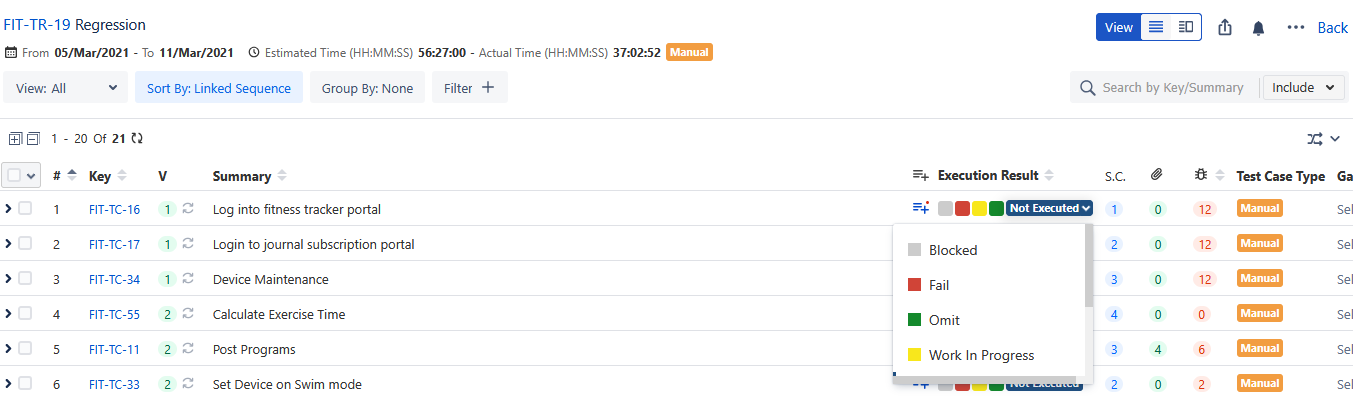
Under the Execution Result column, select the result you want to assign to the Test Case.
If you want to edit the status of the Execution Result, click the existing Execution Result of the test case and select the status from the drop-down.
Note
If the Report Bug setting in Configuration is enabled for the execution result, you must either link an existing bug or create a new bug to associate with the test case, even if you have already linked bugs to the test steps of the test case.
The Execution Result appears disabled if you have not filled in all the mandatory system and custom execution fields. The blank mandatory fields do not allow you to assign execution results to test cases. This restriction does not apply to the Execution Results where the Skip Validation is enabled.
Assign Status to Test Step
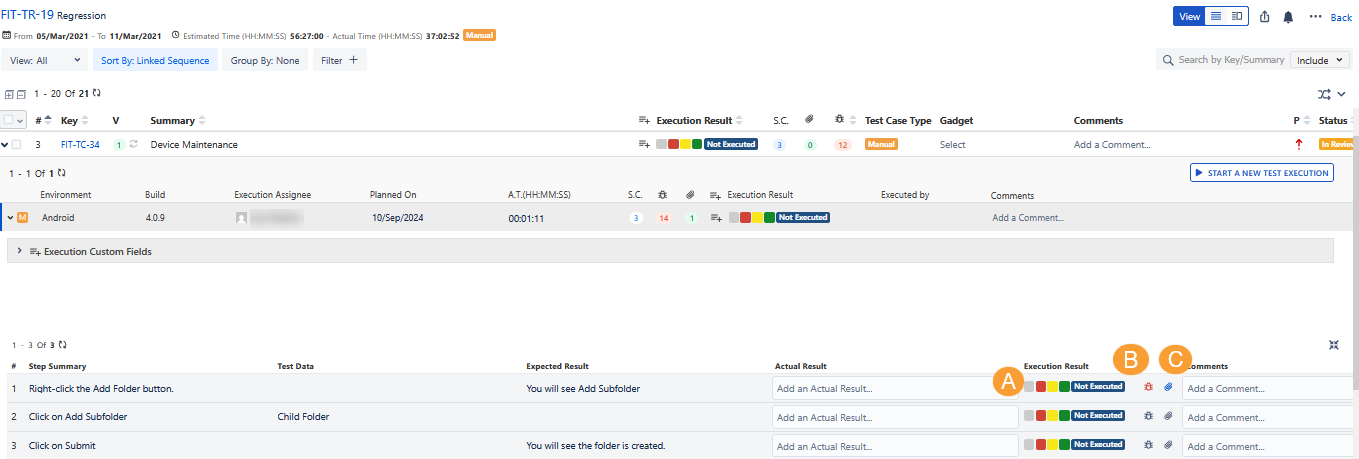
Each Test Case is expandable by clicking on the step count (S.C.) for the Test Case.
If there is any change (add/update) in the steps in the Test Case module, a warning message is shown for the Steps tab indicating the required sync. Click the provided link to sync the steps with the Test Case and update them in the execution screen as described in the Sync Steps section above.
A. Expand to view more execution status. Select the one that you want to assign to the step.
Note
If the Report Bug setting in Configuration is enabled for the execution result, you must either link an existing bug or create a new bug to associate with the test case, even if you have already linked bugs to the test steps of the test case.
The Execution Result appears disabled if you have not filled in all the mandatory system and custom execution fields. The blank mandatory fields do not allow you to assign execution results to test cases. This restriction does not apply to the Execution Results where the Skip Validation is enabled.
B. Click to link a defect to a step.
C. Click the icon to link an attachment to a step.
Actual Time
The Stopwatch feature automatically calculates the actual time taken by testers to execute each test case. The total actual time for all test cases within a test cycle is displayed at the top. Refer to Track Execution Time on List View Execution Screen for more details.
Bulk Update Test Cases from Execution Screen
You can bulk update test case execution results, execution custom fields, execution assignee, environment, build, actual time, and comments.
Assign Build and Environment to Test Cases linked to a Test Cycle
You can change/assign the environment and build for multiple Test Cases at a time on the execution screen. The change in Build will impact the latest execution of the Test Case.
Perform the following steps to assign Build and Environment to test cases:
Select the test cases for which you want to change the Build and Environment values.
Click the Bulk Operations option.
Select Update.
Assign/Change the value of Change Environment and Build in the respective fields.
If you want to keep the Build field blank, then select the Set Field as Blank option on the drop-down list.
Bulk Update Test Execution Results
You can bulk update the execution results of multiple test cases at a time from the execution screen.
Perform the following steps to bulk update test execution results:
Select the test cases you want to execute.
Click Bulk Operations.
Select Update.
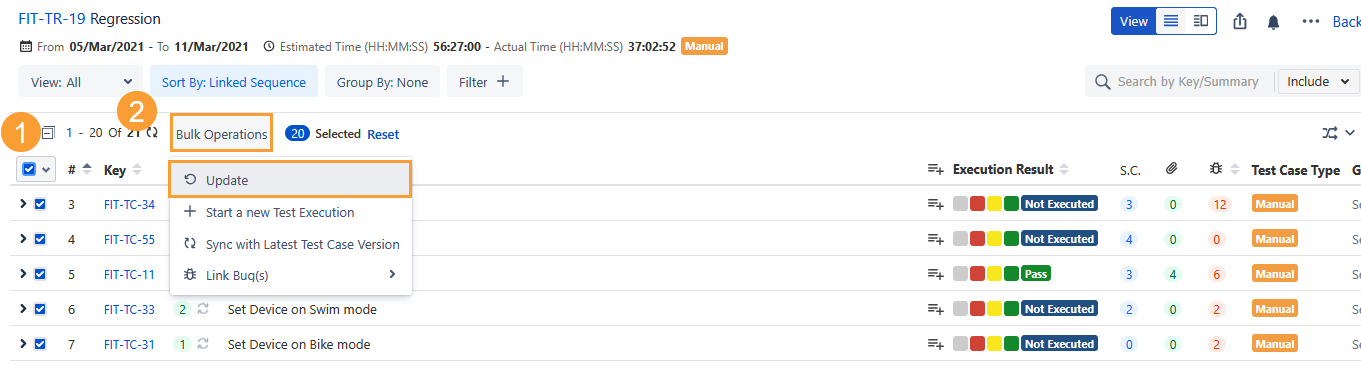
The Update dialog appears.
Select the Execution Result from the Test Execution Result list for all the selected test cases.
If you want to update the execution result of test steps, select the Update Test Step Execution Result checkbox.
Note
If Auto Update Execution Result Preference is ON, the Test Steps Result will also get updated.
Click Update.
Note
If the Report Bug setting in Configuration is enabled for the execution result, you must either link an existing bug or create a new bug to associate with the test case, even if you have already linked bugs to the test steps of the test case.
The test execution results for the selected test cases are updated.
Note
If you have not filled in all the mandatory system and custom execution fields, you can not update the execution result status of the selected test cases. The blank mandatory fields do not allow you to assign execution results to test cases. This restriction does not apply to the Execution Results where the Skip Validation is enabled.
Bulk Update Execution Assignee
You can update the assignee who will execute the test cases from the execution screen. Users can also bulk update the Execution Assignee of multiple test cases at a time from the execution screen.
The Execution Assignee field can be filtered for blank values. The Unassigned parameter is provided for the Execution Assignee filter, using which users can filter the test cases and assign the execution assignee to them.
Perform the following steps to update the execution assignee:
Filter on the Execution Assignee and select the Unassigned check box.
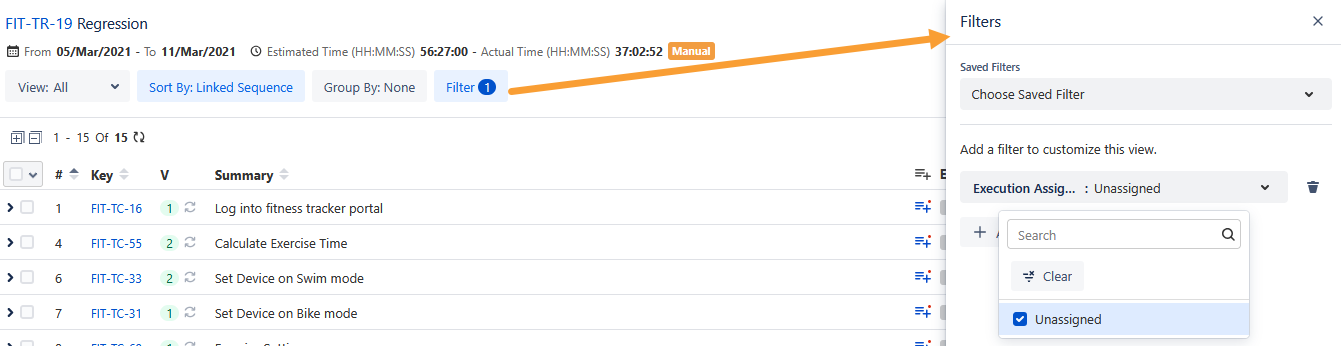
The test cases, for which the Execution Assignee field is blank, will be listed on the screen.
Select the test cases for which you want to update the Execution Assignee field and click Update.
The Update dialog appears.
Select the Execution Assignee from the drop-down list for all the selected test cases.
Click Update.
The Execution Assignee value will be applied to the test cases.