Priority
A Priority defines a Test asset's importance in relation to other test assets. QMetry provides default priorities of Blocker, High, Medium, and Low for all test assets. Default priorities are displayed as 'System Default' priorities.
Default priorities can neither be edited nor deleted. Admin can add custom priorities and custom icons to use them in the test assets. Custom Priorities are added at the Project Level. These custom priorities can be edited as well as deleted.
Note
Required Permissions:
Jira Permissions: Browse Project permissions are required.
QMetry Permissions: If enabled, then the following permissions are required.
Configuration View
Configuration Modify
Adding a Priority
You must have the Configuration Modify permission to the project to create a customized priority.
Perform the following steps to create a priority:
Click the QMetry menu and select Configurations.
Under Project Configuration, select Priority.
Enter name, description, select an Icon to represent the priority, and click Add.
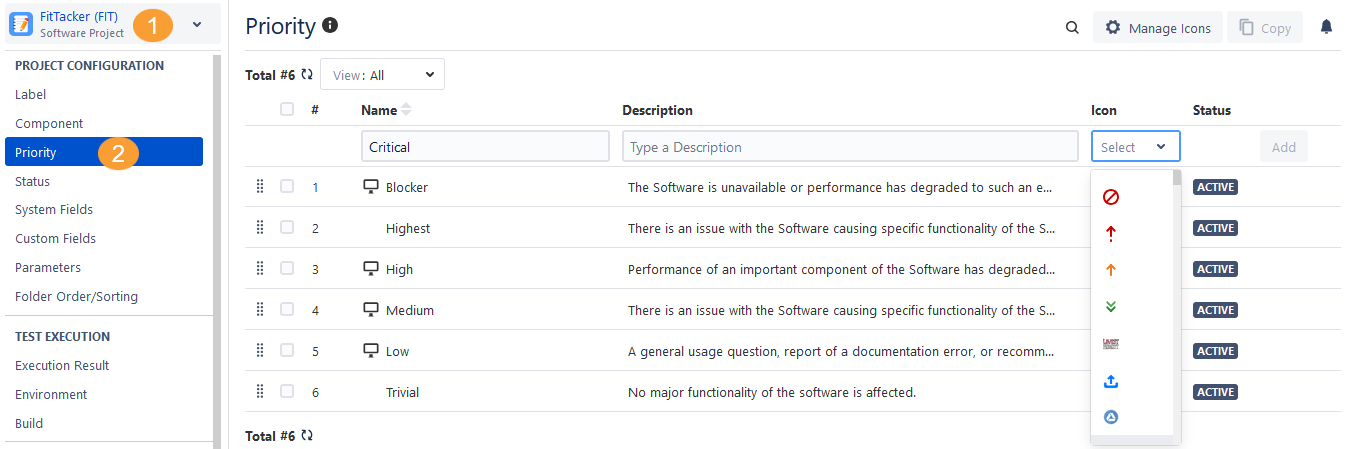
The created priorities are available to link to Test Case, Test Cycle, and Test Plan.
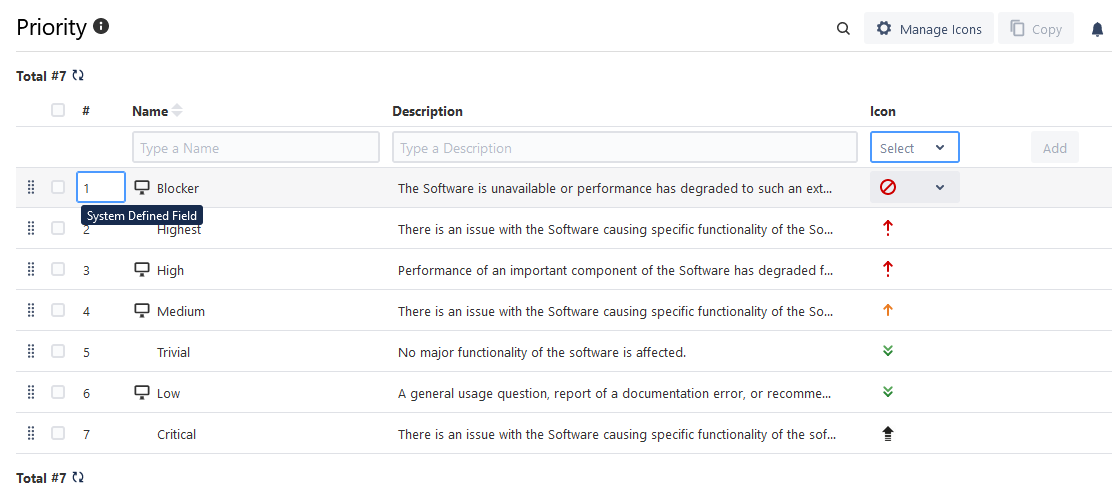
The visual appearance of System Defined Priorities makes it easy to differentiate between System and Custom Priorities.
Adding Custom Icons to Priority
You can add customized icons to the Priority.
Perform the following steps to add custom icons for priorities:
Click the Manage Icons button or click the Icon drop-down list and click Add .
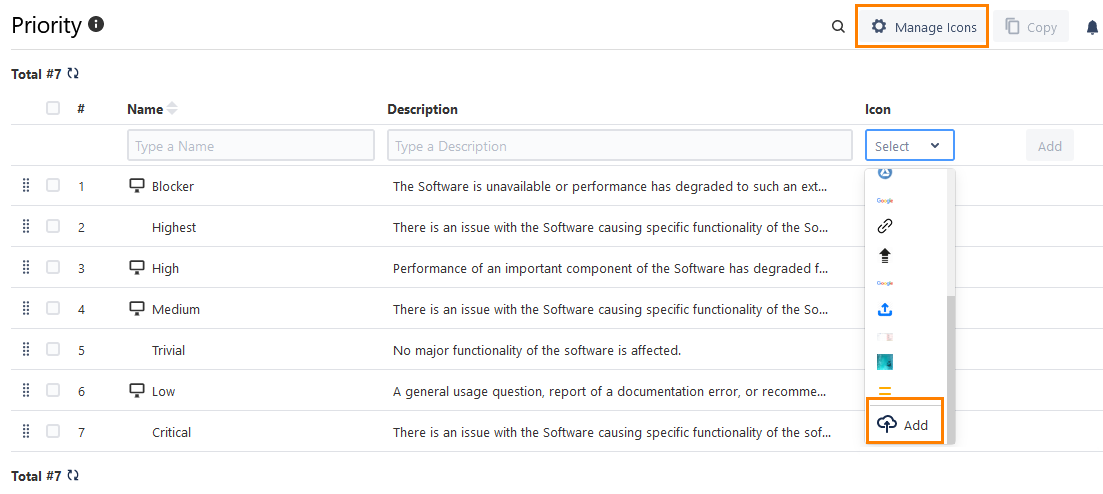
Upload an icon or provide the Image URL.
Editing a Priority
You can edit values ( that is, Name, Description, and Icon) of System and Custom Priorities. Priorities already used in assets will also get updated accordingly. You must have the Configuration Modify rights for the project to edit the priorities.
Note
Modifying priority names resets any existing filters applied to those values.
Perform the following steps to edit a priority:
Click the priority name, and a text box appears to enter the new priority name.
Type the new name and click the tick mark symbol. Edit the Description field and change the icon in a similar manner.
The confirmation message appears. Click Confirm to proceed.
Arranging Priorities
You can arrange the sequence of Priorities as per your requirements. The list of priorities in test assets appears as per the sequence set here.
You can arrange priorities through either of the following ways:
A. Using Drag and Drop
B. Changing the sequence number of the priority value
Copying Priority to Other QMetry Projects
You can copy Priority from one project to another. This functionality allows users to use similar items in different QMetry projects without having to add them individually.
Users can save their time as they do not have to create redundant or duplicate items for different QMetry projects.
Note
To copy priority in other projects, you must have Configuration Modify permission of the targeted project.
Perform the following steps to copy priority to other projects:
Select the Priorities that you want to copy to other QMetry Projects. The Copy button is visible on the screen when you select priorities.
Click Copy.
3. Now select the project where you want to copy the selected items. You can select multiple QMetry Projects (a maximum of five projects) at a time to copy the item.
The system ignores duplicate entities while copying.
Archiving a Priority
You can archive System and Custom Priorities. You must have the Configuration Modify access to the project to archive the priorities. The Archive feature is useful when you want to stop using Priority values but still do not want to delete them. You can bring the archived values back into use by unarchiving those values.
An archived priority value does not appear in the drop-down list for test assets. However, previously used values remain visible in existing entities.
Operation | Impact and Behavior of Archived Values |
|---|---|
Import Test Case | Archived values can not be imported during the test case import operation. It applies to manual import and import via Open API or Automation API. |
Export Test Case | Archived values get exported during the test case export operation. |
Copy List Values | The archived list values do not get copied while copying the list values using the Copy button in the project Configuration section. |
Filter records on list values | Filters can be applied to the archived values. The archived values are displayed under the Archived section on the filter list. |
Entity versioned/updated | The archived list values get copied or preserved as it is. |
Clone in the same project | The operation applies to the Test Case and Test Cycle modules. The archived list values get copied. |
Clone test cycle to other projects | The operation is applicable to the Test Cycle module. The archived values are copied with the “Active” status in other projects. |
Export to another project | The archived list value gets copied with the “Active” status in other projects. |
Cloning or Start New Execution with custom fields | The archived list values get copied. |
Perform the following steps to archive a priority:
Hover the record you want to archive. The Archive icon becomes visible when you hover over the record.
Click Archive.
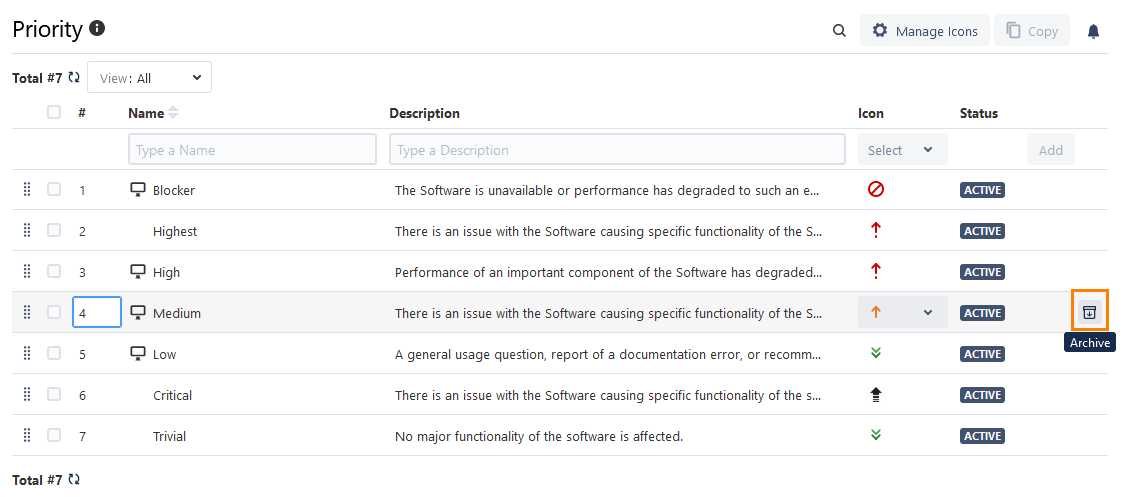
The archived records can be filtered using the Archived button at the top right corner.
In Test Management -
Archived priorities cannot be used in new test assets. However, priorities that are already in use remain visible in existing test assets.
When you apply the Priority filter to test assets, archived priorities appear under the Archived section.
Unarchive an Archived Priority
Once a Priority is archived, the Unarchive icon appears for that Priority. Click the Unarchive icon to unarchive a priority.
Deleting a Priority
The Delete feature is useful when you do not want to use the value anymore by removing it permanently. First, archive the priority before deleting it.
You must have the Configuration Modify permission to delete the custom priority.
Note
You cannot delete system-defined priorities and the priorities that are associated with test assets. Remove all associations before deleting a priority.
Perform the following steps to delete a priority:
Hover over the archived priority that you want to delete. You can see two icons on hover: (1) Unarchive and (2) Delete.
Click the Delete icon for the priority.
Searching for a Priority
You can easily search for a required priority from the long list of items.
Perform the following steps to search for a priority in the list:
Click the QMetry menu, select Configuration, and select the project.
Select Priority.
Click the search icon to see the text box. Type the keyword in the text box and press ENTER on the keyboard.